

- Remove the current class from the content27_link item as Webflows native current state will automatically be applied.
- To add interactions which automatically expand and collapse sections in the table of contents select the content27_h-trigger element, add an element trigger and select Mouse click (tap)
- For the 1st click select the custom animation Content 27 table of contents [Expand] and for the 2nd click select the custom animation Content 27 table of contents [Collapse].
- In the Trigger Settings, deselect all checkboxes other than Desktop and above. This disables the interaction on tablet and below to prevent bugs when scrolling.
Every competitive gamer recognizes the moment. Your mechanics are solid, your setup is perfect, and you’ve put in the hours. Still, under pressure, something slips. A missed shot. A late reaction. A match that unravels for reasons no settings menu can explain.
For decades, gaming performance has been shaped by an arms race in hardware. Faster processors, higher refresh rates, lighter mice, and immersive audio all pushed the ceiling higher. Those advances mattered, but today their impact is leveling off. The difference between good players and exceptional ones is no longer defined by equipment alone.
What increasingly determines performance is cognition. Focus, mental fatigue, and cognitive readiness shape how players respond in critical moments. These internal states influence accuracy, reaction time, and consistency, yet until recently they were largely invisible and understood during play.
Making the Invisible, Visible
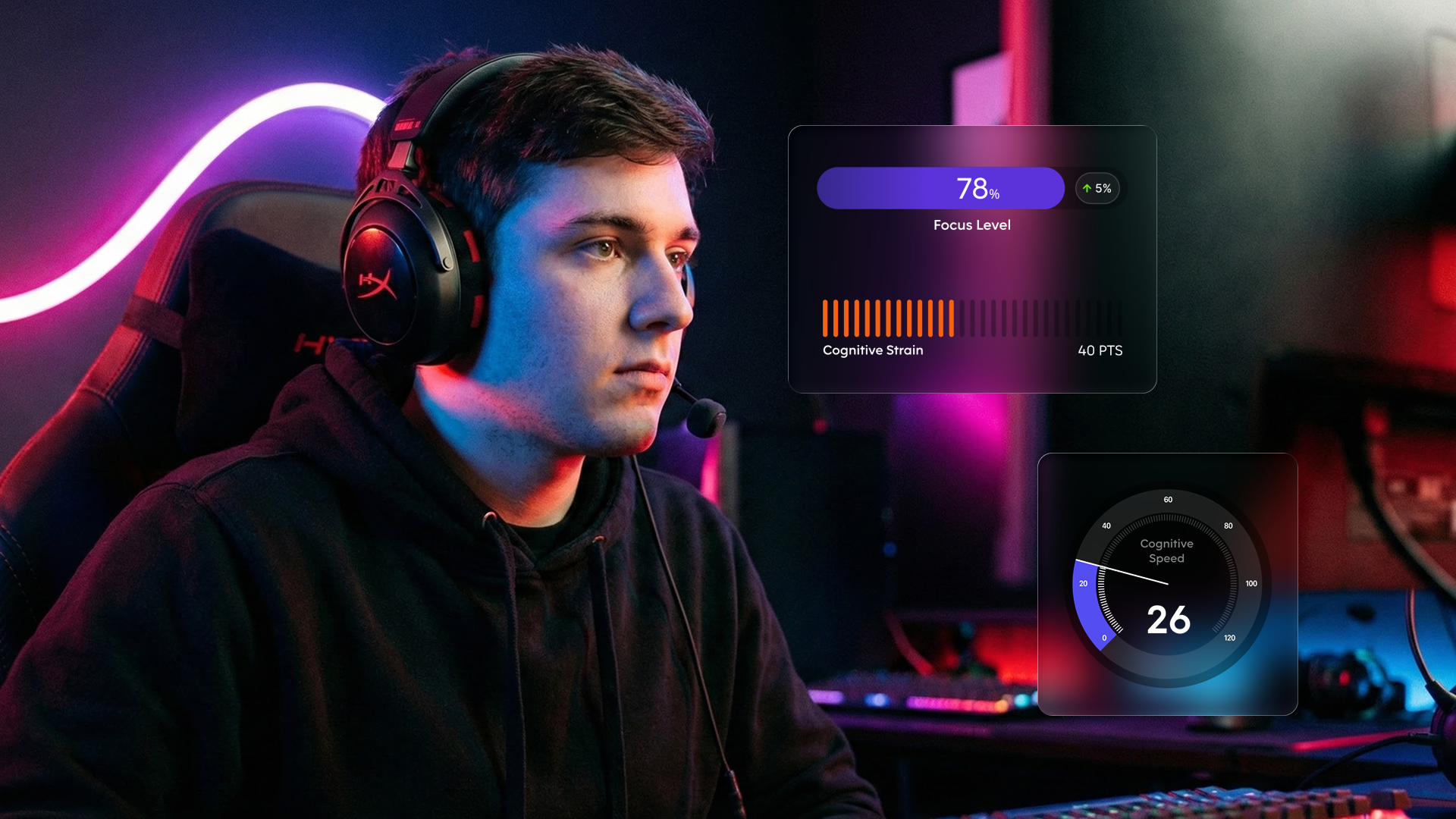
Neurotechnology offers a way to change that. Using non-invasive sensors and real-time signal interpretation, brain-computer interface (BCI) technology makes cognitive states measurable during gaming itself. Rather than guessing when focus drops or fatigue sets in, players can observe how their mental state evolves throughout a session in real time. Athletes have access to fitness trackers, it’s about time they have mental trackers too.
This shifts how performance is understood. Traditional gaming hardware tells players what happened after - where a shot landed, how quickly a target was acquired, and whether a match was won or lost. Neurotechnology adds another layer by revealing why those outcomes occurred. It highlights the mental conditions behind performance, showing when attention sharpens, when cognitive load increases, and how pressure affects responsiveness. That awareness can shape decisions in the moment, without breaking the flow of play.
These tangible effects were shown in early testing of Neurable’s neurofeedback “Prime” system with semi-professional esports athletes. When players received real-time feedback tied to their level of focus, they learned to self-correct. Over time, this can translate into faster reactions, improved accuracy, and more consistent performance in high-intensity scenarios. Each gain may be subtle on its own, but in competitive environments where milliseconds matter, those differences compound.
From Research Labs to Gaming Desks
For much of its history, brain-sensing technology was confined to laboratories and clinical settings. It required specialized equipment, controlled environments, and expert oversight. That limited its relevance to everyday performance and consumer use.
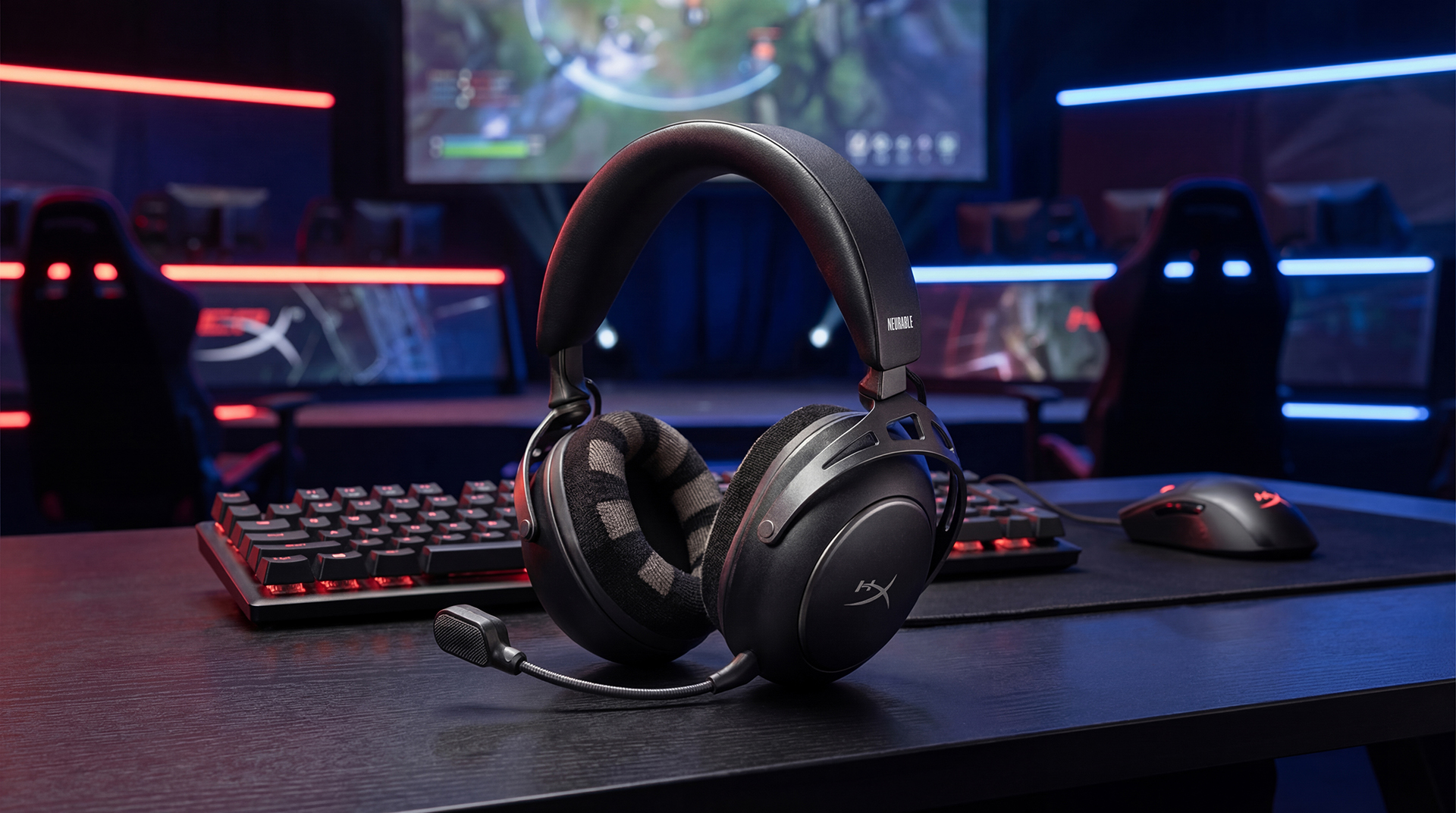
Recent advances in AI modeling, signal processing, and sensor miniaturization have changed that. Neurotechnology can now be embedded into devices people already wear, including gaming headsets. The collaboration between Neurable and HP Inc.’s HyperX, demonstrated at CES 2026, reflects this transition.
The importance of this moment lies less in a single product and more in what it represents. BCI technology is quickly moving from labs to your everyday. When cognitive insight is integrated into trusted peripherals, it becomes part of the experience rather than a distraction. Players do not need to pause or analyze data mid-match. Features like Prime allow this insight to exist quietly in the background, supporting performance without interrupting play.
This integration changes how players improve, whether they are practicing or in the middle of a match. Gaming culture already values optimization through warm-ups, routines, and detailed performance analysis. Cognitive training extends that mindset inward. With insight into focus and fatigue, players can structure practice more intentionally, recognize when performance dips are mental rather than mechanical, and approach long sessions with greater self-awareness. Focus becomes something that can be understood and refined over time.
Gaming’s Expanding Performance Stack
The headset, long associated with immersion, is evolving into something more interactive.. It becomes a window into how players think and respond under pressure. For esports professionals, this has immediate relevance. Long tournaments demand sustained focus, rapid recovery between matches, and resilience under stress. Mechanical training alone cannot address those challenges.
Neurotechnology introduces a new form of practice where mental endurance is trained with the same intention as aim or movement. At the same time, tools like Neurable’s “Broadcast” dashboard surface real-time cognitive insights during live play, giving players, teammates, and coaches a clearer picture of what is happening mentally as a match unfolds. As competitive gaming continues to professionalize, tools that quantify cognitive performance may become as essential as high-refresh displays and precision peripherals.
Gaming as the Front Door to BCI
Gaming has often served as a proving ground for consumer technology. Graphics acceleration, online infrastructure, and virtual reality all matured within gaming before influencing broader digital experiences. BCI technology appears poised to follow a similar path.
Gaming offers a uniquely powerful entry point. Performance matters, engagement is continuous, and feedback is immediate. For professional players, cognitive insight supports peak performance and mental endurance. For streamers and creators, it offers tools to increase immersion with their audience while helping manage long sessions and reduce burnout. For casual players, it opens the door to more responsive and personalized experiences that adapt to how players feel, not just how they perform. Some features are built for deliberate improvement. Others simply make gameplay feel smoother in the background.
As neurotechnology becomes more accessible, it challenges long-standing assumptions about how people interact with digital systems. Most devices today respond only to explicit inputs like clicks and commands. Brain-computer interfaces introduce a more subtle layer of interaction that reflects attention, engagement, and mental effort. The implications extend far beyond gaming, shaping our perspective on productivity, wellness, creativity, and the human-machine relationship.
Gaming is not the endpoint of this shift, but it is a powerful beginning. It is where the value of cognitive insight is immediately clear. What starts as a way to understand focus during play may ultimately redefine how technology adapts to people across work, health, and daily life.
The next evolution of consumer technology will not be defined by innovative hardware alone. It will be shaped by systems that understand the human mind as deeply as they understand machines.
2 Distraction Stroop Tasks experiment: The Stroop Effect (also known as cognitive interference) is a psychological phenomenon describing the difficulty people have naming a color when it's used to spell the name of a different color. During each trial of this experiment, we flashed the words “Red” or “Yellow” on a screen. Participants were asked to respond to the color of the words and ignore their meaning by pressing four keys on the keyboard –– “D”, “F”, “J”, and “K,” -- which were mapped to “Red,” “Green,” “Blue,” and “Yellow” colors, respectively. Trials in the Stroop task were categorized into congruent, when the text content matched the text color (e.g. Red), and incongruent, when the text content did not match the text color (e.g., Red). The incongruent case was counter-intuitive and more difficult. We expected to see lower accuracy, higher response times, and a drop in Alpha band power in incongruent trials. To mimic the chaotic distraction environment of in-person office life, we added an additional layer of complexity by floating the words on different visual backgrounds (a calm river, a roller coaster, a calm beach, and a busy marketplace). Both the behavioral and neural data we collected showed consistently different results in incongruent tasks, such as longer reaction times and lower Alpha waves, particularly when the words appeared on top of the marketplace background, the most distracting scene.
Interruption by Notification: It’s widely known that push notifications decrease focus level. In our three Interruption by Notification experiments, participants performed the Stroop Tasks, above, with and without push notifications, which consisted of a sound played at random time followed by a prompt to complete an activity. Our behavioral analysis and focus metrics showed that, on average, participants presented slower reaction times and were less accurate during blocks of time with distractions compared to those without them.


