

- Remove the current class from the content27_link item as Webflows native current state will automatically be applied.
- To add interactions which automatically expand and collapse sections in the table of contents select the content27_h-trigger element, add an element trigger and select Mouse click (tap)
- For the 1st click select the custom animation Content 27 table of contents [Expand] and for the 2nd click select the custom animation Content 27 table of contents [Collapse].
- In the Trigger Settings, deselect all checkboxes other than Desktop and above. This disables the interaction on tablet and below to prevent bugs when scrolling.
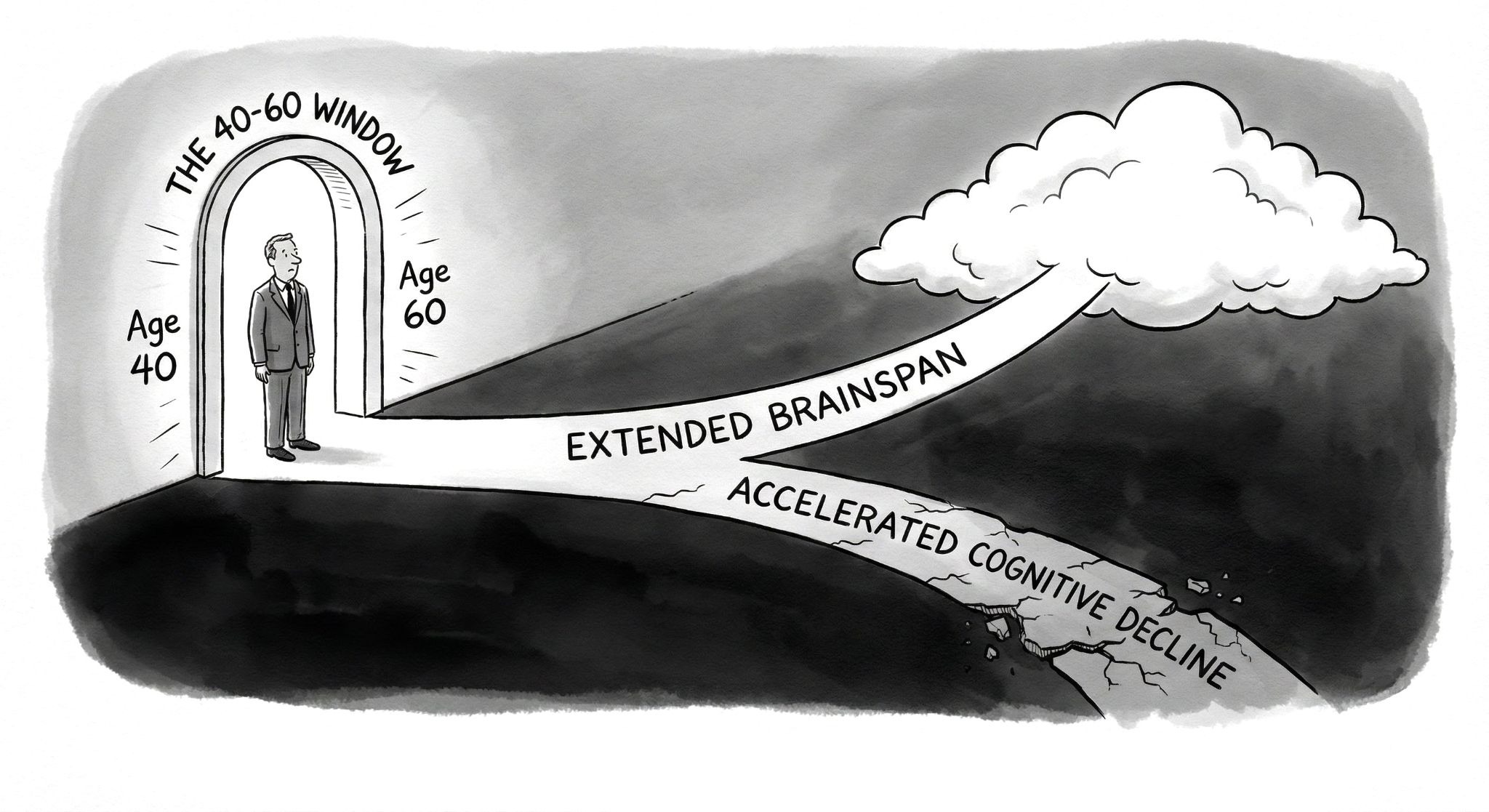
The aging of the human brain is not a uniform, linear process. Just as we are learning more and more that the body does not age linearly (rather in rapid bursts in our 40s and 60s), emerging neuroscience reveals that midlife, specifically the period between ages 40 and 60, represents a critical window of accelerated change where the trajectory for long-term cognitive health is largely determined.
This blog synthesizes current research on the neurobiological shifts that occur during this "40-60 Window," including structural atrophy, functional network destabilization, and the onset of neuronal insulin resistance. It argues that interventions during this period are exponentially more effective than those in later life due to the brain's retained plasticity.
Traditional clinical metrics often fail to detect these subtle, early changes, creating a need for accessible, longitudinal monitoring. This paper posits that wearable neurotechnology, capable of tracking biomarkers like Cognitive Age through daily electroencephalography (EEG), offers a scalable solution. By providing real-time, personalized feedback, such technology can empower individuals to implement targeted lifestyle interventions during this make-or-break period, thereby preserving cognitive reserve and extending brainspan.
1. Introduction: A New Paradigm of Brain Aging
There's a secret window in midlife where your brain's future gets decided. Most people miss it entirely. Here's how to make those years count.
We’ve been taught to think of brain aging as a slow, linear decline that starts somewhere in our 60s. We picture a gentle, predictable slope. But neuroscience is revealing a different, more urgent story. The aging of the human brain is not a uniform process of inevitable decay. Instead, it’s a journey with extended periods of stability punctuated by distinct windows of accelerated change.¹
One of the most critical of these windows opens in our 40s and closes in our 60s. This is the period I call the "40-60 Window." It’s a make-or-break moment for your long-term cognitive health, a time when the trajectory of your brainspan is largely set. The choices you make during these two decades have an outsized impact on your cognitive function for the rest of your life. This isn't a scare tactic; it's insider knowledge that could change everything about how you age.
2. The Neuroscience of the Midlife Brain
So, what is actually happening inside your head during the 40-60 Window? The changes are subtle at first, but they represent a fundamental shift in your brain's biology.
It begins with a slow transformation of the brain's physical structure. After age 40, the brain begins to shrink at a rate of approximately 5% per decade, with the frontal and temporal lobes—the hubs for executive function and memory—being the most vulnerable. But this structural change is a lagging indicator. The real story starts earlier, at the functional level.
Large-scale studies have revealed that our brain's functional networks, which are essential for coordinated thought, begin a period of accelerated destabilization around age 43. The primary driver appears to be the emergence of neuronal insulin resistance. In simple terms, your brain cells become less efficient at using glucose, their primary fuel source. This creates a cerebral energy crisis that disrupts the synchronized firing of your neural networks. At the same time, genes involved in memory and learning begin to show a gradual decline in their expression.
Think of it this way: for the first four decades of your life, your brain's regulatory systems are robust. But during the 40-60 Window, those systems begin to "bend" before they ultimately "break.” This is the critical moment.
3. The Power of Early Intervention
Because midlife is a period of heightened vulnerability, it is also a period of profound opportunity. An intervention at age 45 is exponentially more powerful than the same intervention at age 65. Why? Because at 45, you are working to preserve function and build resilience. At 65, you are often fighting to recover function that has already been lost.
Early intervention is the optimal strategy because it preserves a patient's level of function for longer. It’s the difference between reinforcing a foundation that’s showing a few cracks and trying to rebuild a house after it has collapsed. During the 40-60 Window, your brain still has a high degree of plasticity; it can rewire itself and generate new neurons in response to the right inputs. By acting during this period, you are not just slowing decline—you are actively strengthening your brain's cognitive reserve, making it more resilient to the pathological changes that can lead to dementia later in life.
4. What Traditional Health Metrics Miss
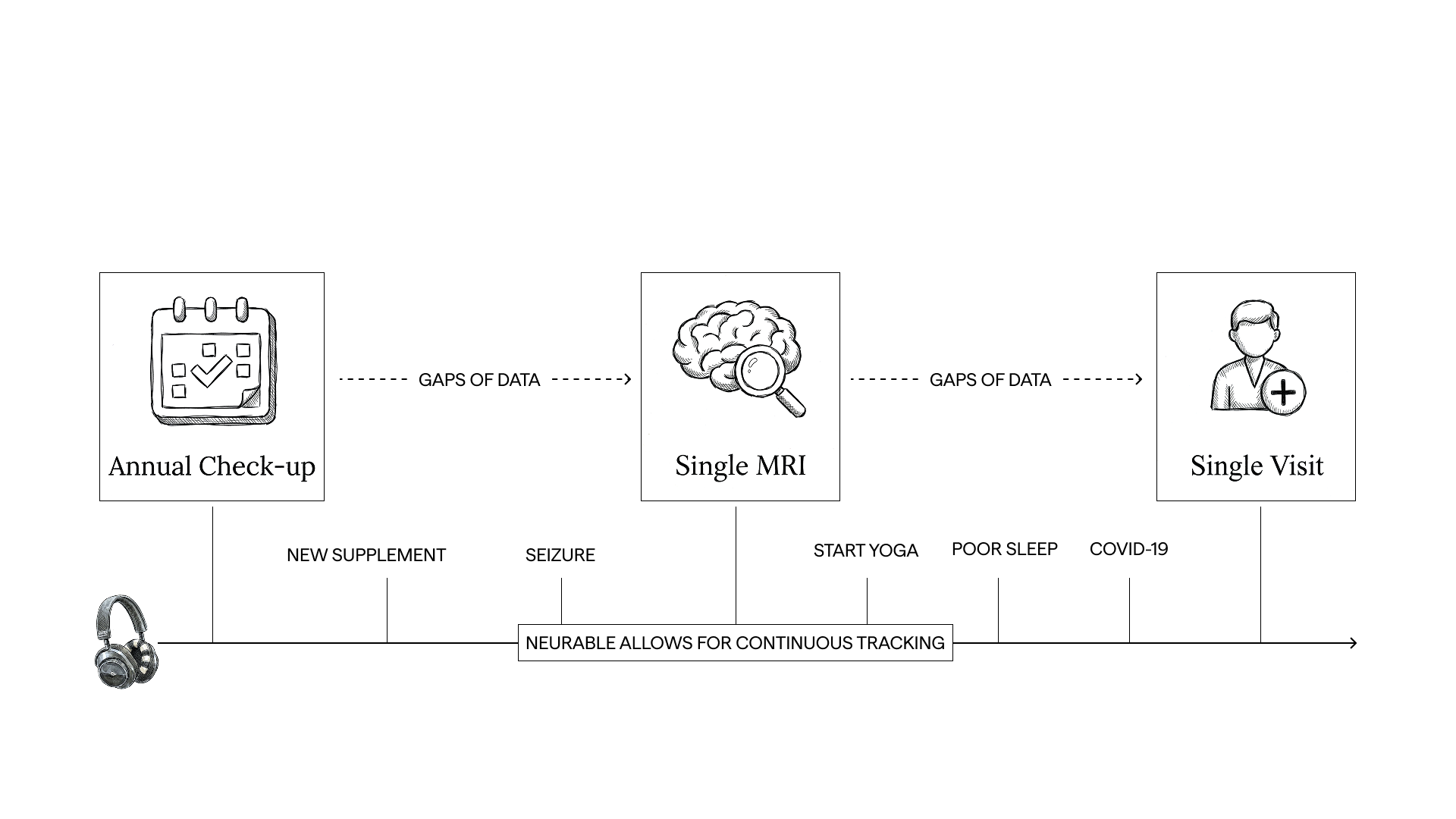
The problem is that these critical midlife changes are invisible to traditional health metrics. Your annual physical and standard blood tests won't tell you that your brain networks are destabilizing. Clinical tools like MRI and PET scans are powerful but expensive, inaccessible for routine monitoring, and typically used only after significant symptoms have already appeared. They provide a snapshot, not a longitudinal story.
This is the gap we are closing at Neurable. For over a decade, my team and I have been on a mission to move brain tracking from the lab into everyday life. We’ve engineered a way to get research-grade data from sensors embedded in a device people already wear daily: headphones. This allows us to reveal what has been hidden.
Our platform introduces a powerful new biomarker for brain health: Cognitive Age. While your chronological age is a static number, your Cognitive Age is a dynamic measure of your brain's health and performance. It tells you how well your brain is aging, and it can fluctuate based on your daily habits. Biology, we know, is more important than chronology.
5. Case Studies: Catching Cognitive Changes Early
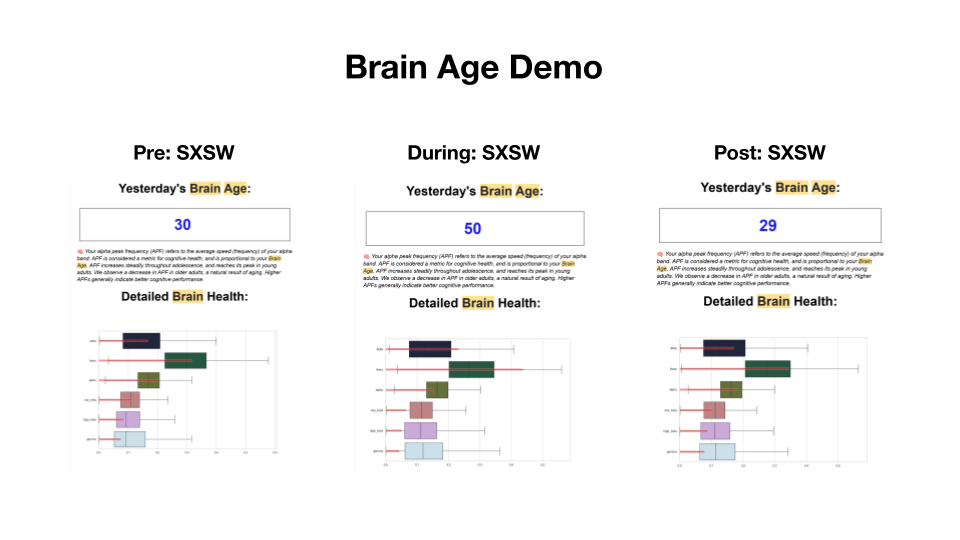
This isn't theoretical. Users see it in their data every day. I saw it in my own data. During the SXSW conference, a week of late nights and irregular habits caused my Cognitive Age to spike from my chronological age of 30 to 50. My EEG data showed elevated delta and theta waves, clear signs of fatigue. When I returned to my normal routine, my Cognitive Age returned to its baseline. This is the power of real-time feedback.
We have users who, for the first time, are seeing the invisible patterns of their own minds. One user told us, "Before these headphones I was beholden to the whims of my energy levels and mood. I can finally understand more about how my mind works." This self-awareness is the first and most critical step toward intervention. Another user, after tracking their data for a week, saw their ability to enter and sustain deep focus improve. They were able to identify the times of day they were most productive and structure their work accordingly. They didn't just see the data; they acted on it and saw a real change.
6. The Lifestyle Interventions That Actually Move the Needle
The good news is that the interventions that have the biggest impact on your brainspan are accessible to everyone. The science is clear: we have more control over our brain health than we ever imagined.
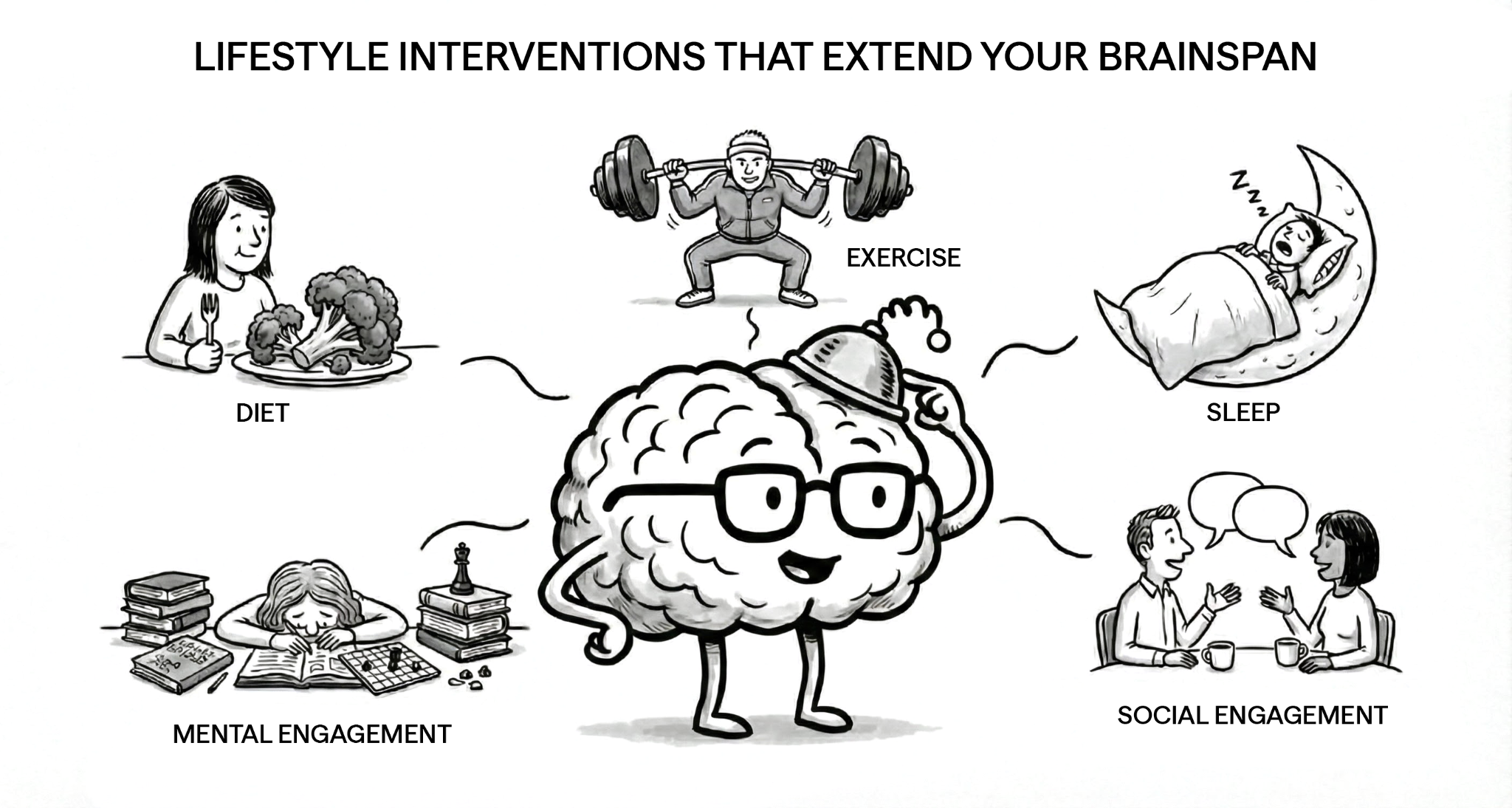
- Diet: Adopt a brain-healthy diet like the MIND diet, which is a hybrid of the Mediterranean and DASH diets. It emphasizes foods like leafy greens, berries, nuts, fish, and olive oil, which are rich in neuroprotective nutrients and anti-inflammatory compounds.
- Exercise: Regular physical activity is one of the most powerful things you can do for your brain. Even moderate exercise like brisk walking increases blood flow, delivers more oxygen to the brain, and can even help grow new brain cells.
- Sleep: Prioritize 7 to 9 hours of quality sleep per night. During deep sleep, your brain's waste clearance system, known as the glymphatic system, is most active, clearing out toxins that can accumulate and contribute to neurodegeneration.
- Mental & Social Engagement: Challenge your brain by learning a new skill, reading, or playing strategy games. Stay socially connected. These activities build what is known as "cognitive reserve," your brain's ability to withstand neurological damage without showing clinical symptoms.
7. How Neurable Reveals What's Hidden
These interventions are powerful, but their effects can be subtle and accumulate over time. Without a way to measure their impact, it can be difficult to stay motivated. This is where Neurable changes the game. Our technology provides the objective data and real-time feedback needed to turn abstract wellness advice into a personalized, actionable plan.
By establishing a personal health baseline, you create a reference point for your body's normal functioning. This allows for the detection of deviations that may signal the onset of illness, often before symptoms manifest. Following that same SXSW conference, my weekly brain health report showed an anomaly in my alpha wave activity. Despite feeling fine, this irregularity preceded the onset of COVID-19 symptoms the next day. This experience underscores the sensitivity of EEG in detecting early physiological changes.
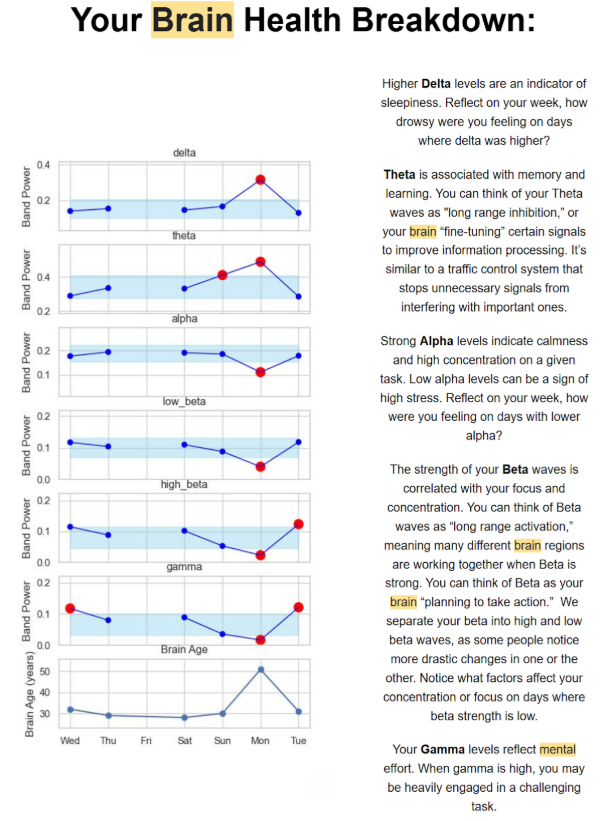
But the implications of this go far beyond predicting a single illness. Imagine this same principle applied not just day to day, but year to year, especially within the 40-60 Window. Subtle, persistent shifts in your brain's baseline activity from one year to the next can be the earliest whispers of long-term cognitive aging. Longitudinal EEG studies have shown that changes in brainwave patterns, like increases in slow-wave activity, are correlated with cognitive deterioration in conditions like Parkinson's and Alzheimer's disease.¹⁶,¹⁷
By establishing your personal baseline and tracking it over time, you are creating your own longitudinal study. This allows you to see the trajectory of your brain health, giving you the power to intervene during that critical midlife window when those interventions are most effective.
The 40-60 Window is not a reason for fear; it is a call to action. It is the single greatest opportunity you have to take control of your cognitive future. For too long, we have been flying blind, unaware of the critical changes happening in our brains. Now, for the first time, we have a window not just into the problem, but into the solution.
This is the future we are building. A future where we are not limited by what we can't see. A future where we have the tools to understand our own minds and the power to change them.
Referenced Research
- The Aging Brain: A Neurogeriatric Framework for Identifying Critical Periods, Implementing Multi-Modal Tracking, and Intervening for Cognitive Longevity. Stony Brook University News
- "Brain aging shows nonlinear transitions, suggesting a midlife 'critical window' for metabolic intervention." Proceedings of the National Academy of Sciences (PNAS).
- "Brain aging shows nonlinear transitions, suggesting a midlife 'critical window' for metabolic intervention." PubMed Central.
- "The Wonders of the Middle-Aged Brain." On The Brain: The Harvard Mahoney Neuroscience Institute Letter.
- "How the Aging Brain Affects Thinking." National Institute on Aging.
- "Mental Health and Aging." Johns Hopkins Medicine.
- "Longitudinal EEG changes correlate with cognitive measure deterioration in Parkinson's disease." PubMed.
- "Resting-state EEG predicts cognitive decline in a neuropathologically diagnosed longitudinal community autopsied cohort." PubMed.
2 Distraction Stroop Tasks experiment: The Stroop Effect (also known as cognitive interference) is a psychological phenomenon describing the difficulty people have naming a color when it's used to spell the name of a different color. During each trial of this experiment, we flashed the words “Red” or “Yellow” on a screen. Participants were asked to respond to the color of the words and ignore their meaning by pressing four keys on the keyboard –– “D”, “F”, “J”, and “K,” -- which were mapped to “Red,” “Green,” “Blue,” and “Yellow” colors, respectively. Trials in the Stroop task were categorized into congruent, when the text content matched the text color (e.g. Red), and incongruent, when the text content did not match the text color (e.g., Red). The incongruent case was counter-intuitive and more difficult. We expected to see lower accuracy, higher response times, and a drop in Alpha band power in incongruent trials. To mimic the chaotic distraction environment of in-person office life, we added an additional layer of complexity by floating the words on different visual backgrounds (a calm river, a roller coaster, a calm beach, and a busy marketplace). Both the behavioral and neural data we collected showed consistently different results in incongruent tasks, such as longer reaction times and lower Alpha waves, particularly when the words appeared on top of the marketplace background, the most distracting scene.
Interruption by Notification: It’s widely known that push notifications decrease focus level. In our three Interruption by Notification experiments, participants performed the Stroop Tasks, above, with and without push notifications, which consisted of a sound played at random time followed by a prompt to complete an activity. Our behavioral analysis and focus metrics showed that, on average, participants presented slower reaction times and were less accurate during blocks of time with distractions compared to those without them.

.png)
