- Remove the current class from the content27_link item as Webflows native current state will automatically be applied.
- To add interactions which automatically expand and collapse sections in the table of contents select the content27_h-trigger element, add an element trigger and select Mouse click (tap)
- For the 1st click select the custom animation Content 27 table of contents [Expand] and for the 2nd click select the custom animation Content 27 table of contents [Collapse].
- In the Trigger Settings, deselect all checkboxes other than Desktop and above. This disables the interaction on tablet and below to prevent bugs when scrolling.
The human body is the most data-rich environment on Earth, yet for decades, the most important organ in that system—the brain—has remained a "black box." At this year’s CES, our CEO, Dr. Ramses Alcaide, took the stage for an eye-opening panel on Body-Based Tech to discuss how we are finally changing that.
Joined by leaders from across the wearable and VR landscape, Ramses shared Neurable’s vision for a world where "brain-computer interfaces" (BCIs) aren't just for sci-fi movies or clinical labs, but are built into the devices we already wear every day.
Beyond the Heart Rate: Why Brain Data is the Next Frontier
Most current wearables focus on the neck down—steps, heart rate, and oxygen levels. While valuable, Ramses pointed out a critical gap:
"The brain is the most powerful organ in our body, and yet it's the least one tracked."
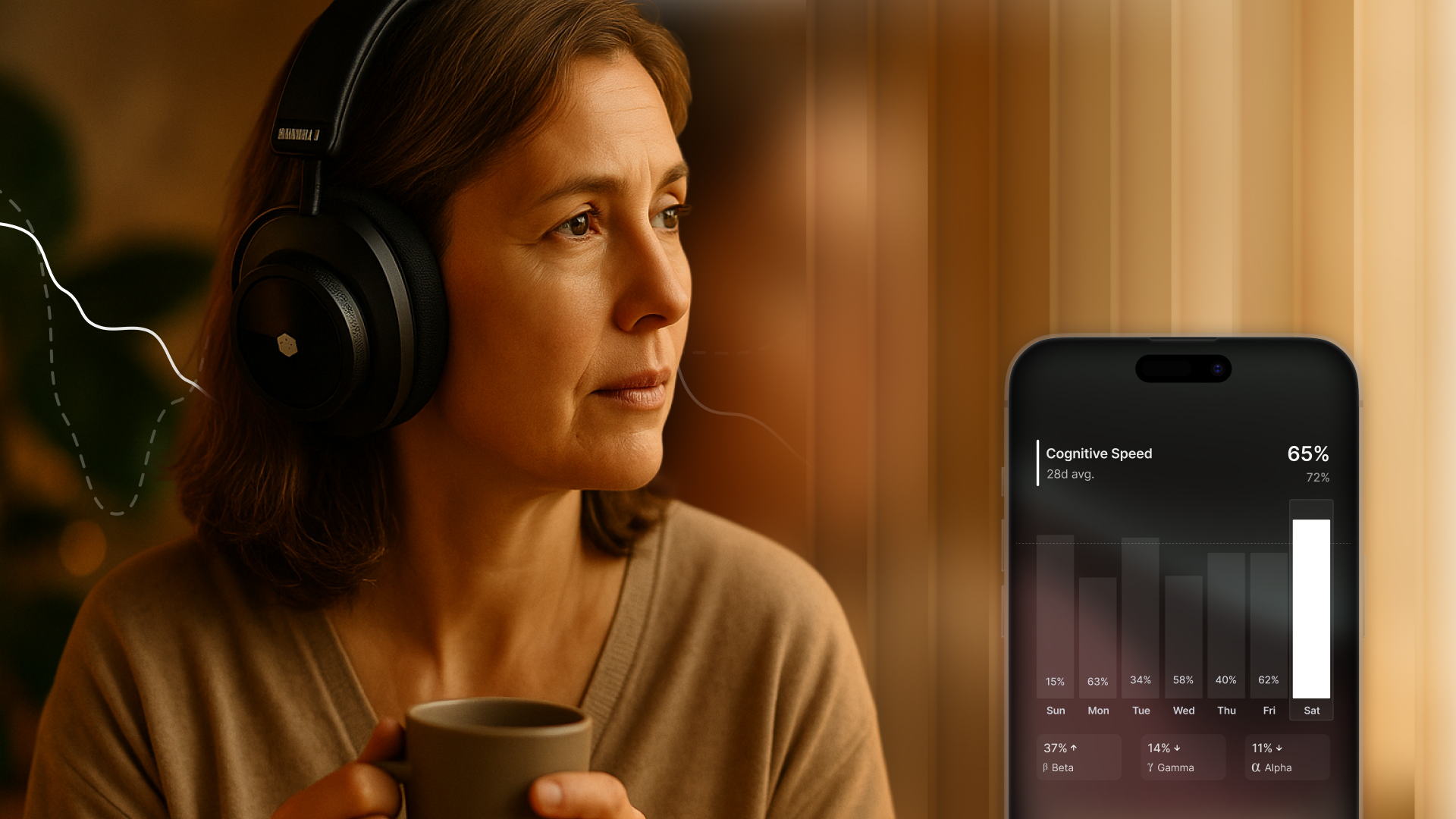
By integrating EEG sensors into standard form factors like headphones and earbuds, Neurable is enabling longitudinal brain tracking. This allows us to see how focus, stress, and fatigue affect us in real-time and over years, providing a "Fitbit for the brain" that can detect burnout before it happens and potentially identify early markers of cognitive decline.
Watch the Highlights
Check out this video to see Ramses demonstrate how our technology tracks focus in real-time and how a simple audio "nudge" can help users with ADHD—and anyone else—stay in the zone.
What’s Next?
The "breakout decade for neurotech" is here. We are moving toward a future where technology doesn't just respond to your clicks, but anticipates your needs based on your cognitive state. Interested in learning more and partnering with Neurable on the future of tech? Reach out to us.
2 Distraction Stroop Tasks experiment: The Stroop Effect (also known as cognitive interference) is a psychological phenomenon describing the difficulty people have naming a color when it's used to spell the name of a different color. During each trial of this experiment, we flashed the words “Red” or “Yellow” on a screen. Participants were asked to respond to the color of the words and ignore their meaning by pressing four keys on the keyboard –– “D”, “F”, “J”, and “K,” -- which were mapped to “Red,” “Green,” “Blue,” and “Yellow” colors, respectively. Trials in the Stroop task were categorized into congruent, when the text content matched the text color (e.g. Red), and incongruent, when the text content did not match the text color (e.g., Red). The incongruent case was counter-intuitive and more difficult. We expected to see lower accuracy, higher response times, and a drop in Alpha band power in incongruent trials. To mimic the chaotic distraction environment of in-person office life, we added an additional layer of complexity by floating the words on different visual backgrounds (a calm river, a roller coaster, a calm beach, and a busy marketplace). Both the behavioral and neural data we collected showed consistently different results in incongruent tasks, such as longer reaction times and lower Alpha waves, particularly when the words appeared on top of the marketplace background, the most distracting scene.
Interruption by Notification: It’s widely known that push notifications decrease focus level. In our three Interruption by Notification experiments, participants performed the Stroop Tasks, above, with and without push notifications, which consisted of a sound played at random time followed by a prompt to complete an activity. Our behavioral analysis and focus metrics showed that, on average, participants presented slower reaction times and were less accurate during blocks of time with distractions compared to those without them.
.jpeg)